
Statement on the consultation on the amendment to the Climate Protection Ordinance (KlV)
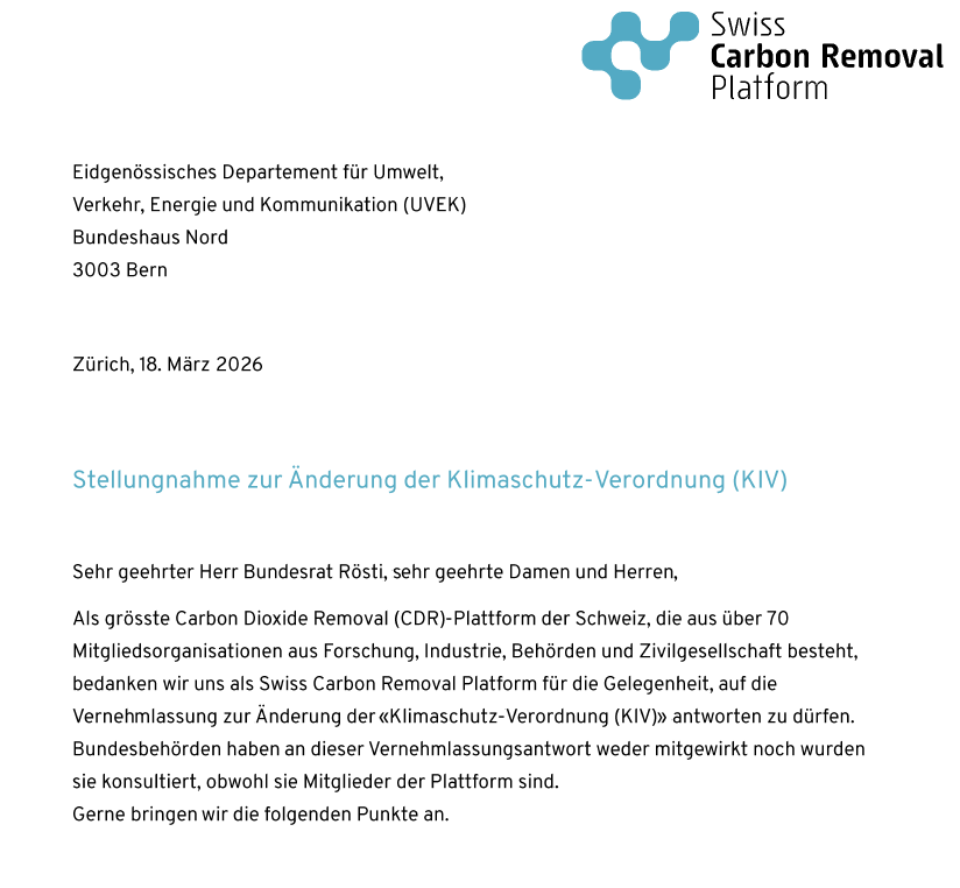
The Swiss Carbon Removal Platform has submitted a statement on the amendment to the Climate Protection Ordinance (KlV) as part of the ongoing consultation process
The Swiss Carbon Removal Platform expressly welcomes the thrust of the proposal to amend the Ordinance. We have included the following key points in our statement:
Prioritization of national negative emission technology certificates: The open wording in Art. 30a para. 3 allows for the net zero targets to be met exclusively with foreign certificates. We request that the FOEN use national certificates as far as possible for procurement in order to strengthen the development of negative emission technologies in Switzerland.
Specification of Scope 3 consideration: The current draft provides for upstream and downstream emissions to be taken into account "gradually", with no time limit. We propose that full coverage of the main Scope 3 emissions should be achieved by 2030 at the latest in order to ensure planning certainty and verifiability.
Interim targets in the roadmaps: In order to be able to assess progress at an early stage and correct it if necessary, we recommend including explicit interim targets for 2030 and 2035 in the roadmaps.
Transparency for residual emissions: In reporting, a clear distinction should be made between emission reductions, remaining residual emissions and their compensation through negative emission technologies (NET). Only in this way can the achievement of targets be presented in a credible and comprehensible manner.
Support for cantons: The planned implementation aids in accordance with Art. 30f should go beyond guidelines and include coordinating elements, such as joint instruments or structured exchange formats, in order to relieve the burden on smaller cantons in particular.
Background
The Federal Act on Climate Protection Targets, Innovation and Strengthening Energy Security, or Climate and Innovation Act (KlG) for short, was passed by Parliament in 2022 and approved by the electorate in 2023. It enshrines the net-zero target for 2050 and the goals of the Paris Agreement in national law. Key elements include reduction pathways for individual sectors, the promotion of innovative technologies and the obligation of the Confederation and cantons to act as role models in reducing emissions.
The Climate Protection Ordinance (KlV) specifies the framework requirements contained in the KlG at ordinance level. The first version came into force on 1 January 2025 and regulated, among other things, the promotion of technology in industry and the impulse program in the building sector. The implementation of the Confederation's exemplary function in accordance with Art. 10 KlG was postponed at the time. The amendment to the KlV, which is now being consulted on, makes up for this and specifies how the federal administration and cantons are to fulfill their net-zero obligations in concrete terms.
The planned amendment to the ordinance
The amendment to the Climate Protection Ordinance submitted for consultation specifies the exemplary function of the Confederation and cantons in accordance with Article 10 KlG. The key points:
- The central federal administration is to achieve the net-zero target by 2040, ten years earlier than Switzerland as a whole. Direct, indirect, upstream and downstream emissions (Scope 1, 2 and 3) are taken into account.
- The Armed Forces, the Defense Group and armasuisse are granted an exemption due to special technical and security policy features and do not have to achieve the net-zero target until 2050.
- The cantons, decentralized federal administration and federal-affiliated companies should strive for the 2040 target, but are not obliged to do so.
- Binding roadmaps will be introduced, which will be drawn up from 2027 and updated every four years. The Federal Department of the Environment, Transport, Energy and Communications (DETEC) for the Federal Administration and the Federal Department of Defense, Civil Protection and Sport (DDPS) for the armed forces are responsible for coordination and reporting.
- The Federal Office for the Environment (FOEN) centrally procures the necessary certificates for negative emission technologies.
- The amendment to the ordinance will enter into force on September 1, 2026.