
Site Visit Neustark - Blogpost
Lighthouse Series
What is neustark?
Neustark, member of the Swiss Carbon Removal Platform, is a Swiss company that enables permanent CO2 storage by storing biogenic captured CO2in recycled mineral waste such as demolished concrete and, hence generating negative emissions. Founded in 2018, neustark as of today counts a team of 50 people and operates on 48 capture and storage sites. With the working group R&D, Innovation and Pilots we had the opportunity to visit one of the neustark sites and learn about neustarks’ scaling and their technology.
How does their CDR method work?
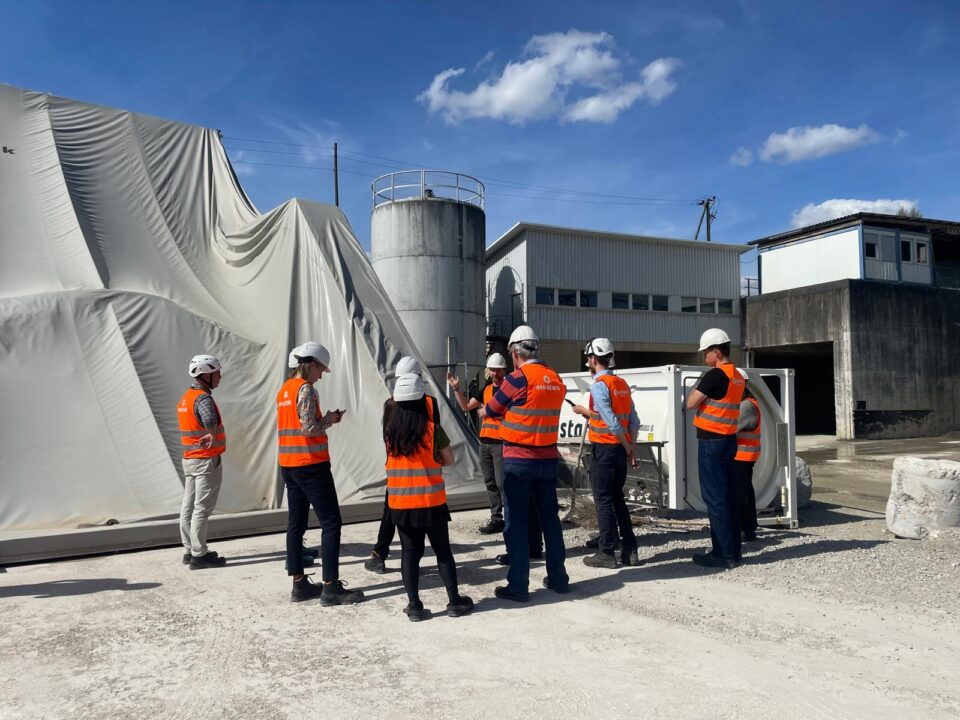
During our visit we did not solely get to ask our burning questions, we also had the chance to see the technology and received a presentation on the workings of it. neustark buys the captured CO2 and transports it in a liquid state to nearby sites. They partner with construction recyclers, so that their technology is located directly at the recycling site. We visited the alluvia site on the outskirts of Bern. At the site the liquified CO2 goes through an atmospheric vaporizer to turn it back into a gas, that then can be injected into the demolition aggregate (e.g. concrete). By injecting CO2 in demolished concrete, it turns into limestone and is permanently removed from the atmosphere The key here: the captured CO2is always from biogenic sources, so that through the storage of Co2 in the demolition aggregate actual negative emissions are created.
What is their business case?
Did neustark find a business case that also supports the climate? Concrete is one of the world’s largest CO2emitters, however it is also considered an unavoidable emission. By injecting CO2 into concrete, you not only generate permanent CDR storage, and therefore a CDR credit but also create a concrete product that has a decreased CO2footprint. Their selling point? They support the entire process, from capturing to storing - and the impact is immediate. In contrary to other CCS methods, they can directly store the CO2 into demolished concrete, making it a fast and impactful solution for permanent storage.
From idea to scale-up
As mentioned above, neustark has grown rather quickly since their founding and are currently in the “scale-up” stage. So how did neustark manage to grow so quickly and turn an idea into being an established player in the Swiss CDR markets? We asked and identified some key enablers for the scaling of a start-up.
- First of all – the investments. They started with Early State Investors and then followed this with Series A investors. Series A refers to the first major round of venture capital investment that a start-up raises.
- Further, we were told that in the start-up phase the space and actors who let you just “do” and try things out, are the ones that really support the development of a start-up. In a later stage, to scale and grow from a start-up level, you need a company who is willing to take the risk. Lastly, the jump to becoming an international working company, was enabled by neustarks partnerships.
- Another important factor are also the buyers. Having multiple buyers with some long-term offtake agreements helped neustark spread its risk. This is a learning that can be adapted to other start-ups as well.
A further enabler mentioned, is neustark’s business idea with immediate removal of CO2. Compared to other solutions neustark’s solution offers immediate removal of CO2, which attracts investors and buyers compared to more solutions that only become visible in the long-term. The last factor of enablement, that was not explicitly mentioned but became clear in our conversations was the location and regulations in Switzerland. In contrary to other countries, recycling concrete in Switzerland is seen as very valuable and the country has very progressive concrete norms. This allows for CO2 storage options in concrete. In addition, the country of Switzerland offers a flourishing environment for start-ups, especially in the CDR space. Potential offtake companies often have a prior understanding of CDR and are willing and open to new options. Hence, not only the investments but also the location probably played a big part in neustark’s success.
The visit at neustark was inspiring, as it gave our group insight into the workings of a successful CDR start up. Thank you for showing us around!