
Climeworks Site Visit
Direct Air Capture, Innovation Center and Booster Pitches
On the 31st of August, the innovation group of the Swiss Carbon Removal Platform was welcomed by Climeworks to their Innovation Center in Zurich. Climeworks is a founding member of the Swiss Carbon Removal Platform since its start in 2021. During an afternoon together, the group was guided through the Innovation Center to see the Direct Air Capture (DAC) technology and received a perspective into the work of Climeworks Solutions, the company’s carbon removal portfolio business. Providing insight into the learnings of a carbon removal pioneer, the inspiring afternoon concluded with pitches from this year's CDR Booster cohort.
But what does Climeworks actually do? Climeworks was founded by Jan Wurzbacher and Christoph Gebald, who met at ETH Zurich and bonded over a passion to tackle climate change. The company was founded in 2009 and has since then become a global leader in Direct Air Capture technology and carbon removal portfolios. Its technology captures CO₂ directly from the atmosphere using collectors that contain a filter material, a sorbent, that binds CO₂ molecules. Once the sorbent is saturated, the collectors are closed and the temperature is increased to 100 degrees Celsius. This process releases concentrated CO₂ which subsequently is permanently stored underground.
In 2017, Climeworks built their first commercial-scale DAC plant in Hinwil, Switzerland, and four years later their first Direct Air Capture and Storage plant called Orca in Iceland. The first large-scale deployment of Direct Air Capture and Storage followed in 2024 with their plant Mammoth in Iceland.
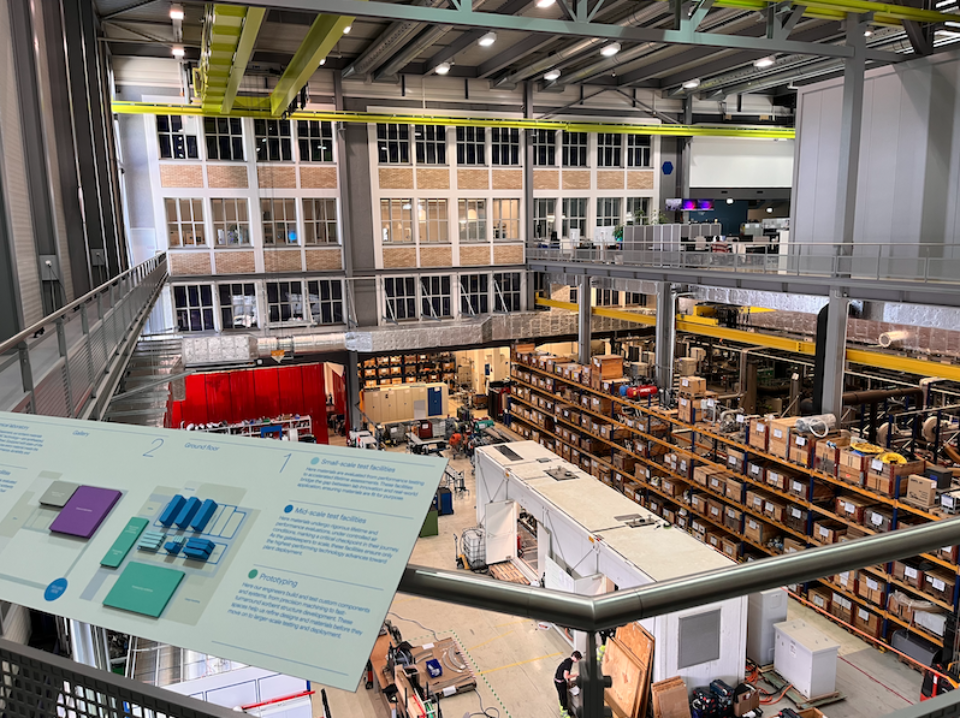
At the Climeworks Innovation Center, which employs approximately 55 engineers, they are currently pursuing the goal of making Direct Air Capture more efficient and bringing down costs. This includes three research areas: Improving the filter material/sorbent, extending the lifetime of the material, and working on the mechanics of the machine. With this set-up, materials down from Climeworks managed to bring a full innovation cycle for new capture several months to just 6 days. You can imagine what that means for the speed of R&D – and how much fun it must be to work there as an engineer!
The Journey is the Destination
In addition to the above-mentioned work in their Innovation Center, Climeworks is focusing on understanding how different climatic conditions affect plant performance. While the early phases were largely centered on growth, the emphasis today is on balancing scaling efforts with operational learning and cost reduction. Running the first facilities provided valuable insights into how the technology performs under Iceland's unique climatic conditions. This learning has now been considered while building their Generation 3 plants. A mobile test facility (see picture) allows Climeworks to test the technology under a range of weather conditions. As Christian Sutter explained to us, the Mobile Test Facility we saw in the center had just made its way back from Saudi Arabia and will now be sent to Canada, where it will gather data under extremely cold conditions. The takeaway? The successful scaling of a project depends on more than fast innovation cycles - testing and learning are equally vital to mature the technology for large-scale deployment.
For 10 Gt we need a portfolio of CDR approaches
Climeworks has a dual challenge: They want to deliver the world's highest performance, lowest cost DAC and build the carbon removal market at the same time.
According to the 2024 State of Carbon Dioxide Removal report, around 7 to 9 gigatons of carbon dioxide per year must be removed from the atmosphere by 2050 to successfully reach global net-zero goals. DAC is expected to be a critical part, but achieving global climate goals will require a portfolio of carbon removal approaches.
This is something that Climeworks Solutions knows too well. To ensure that the CO₂ credits offered are of the highest quality, Climeworks Solutions curates portfolios that combine nature-based and engineered credits, placing particular emphasis on monitoring, reporting and verification.
When asked why Climeworks does not focus exclusively on DAC, the company pointed to the growing demand for diversified, high-quality credit portfolios. Such portfolios allow businesses to invest in a range of solutions today while simultaneously supporting the long-term scale-up of DAC.
The site visit was a great opportunity to see CDR innovation at work and at the same time network and reflect on the challenges and opportunities on the technology and the market side.
A big thanks to Christian, Nils and the whole Climeworks team for having us, and for Sophia and the Carbon Removal Innovation Booster for their great work and the inspiring pitches!