
Spotlight on CDR: Highlights on the path to “Net Zero”
Climate Week Zurich 2026
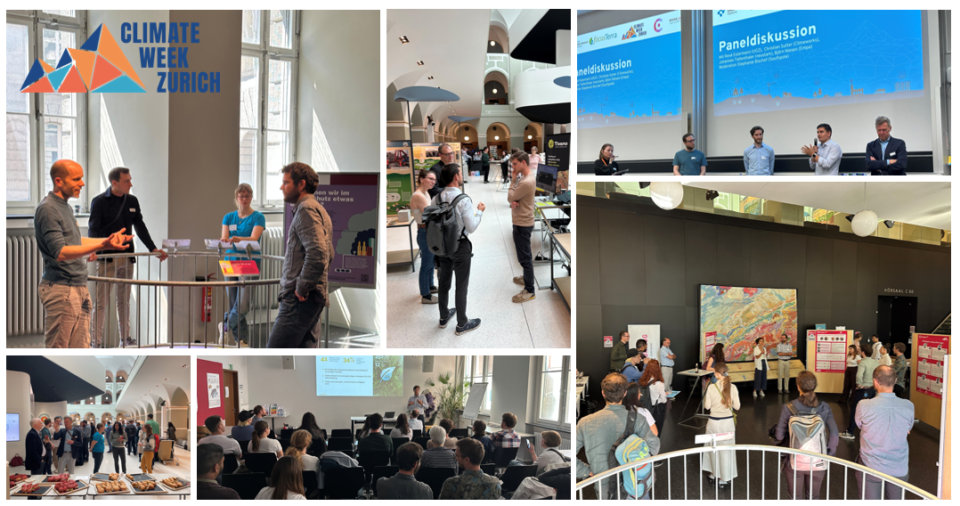
During the first Climate Week Zurich, the Swiss Carbon Removal Platform hosted a full day of events at the focusTerra special exhibition “KEEPITCO2OL” at ETH Zurich, exploring how Carbon Dioxide Removal (CDR) can contribute to achieving net-zero targets. Following a keynote and panel discussion, participants attended engaging presentations on various CDR approaches. During the breaks, visitors had the opportunity to explore the exhibition and connect with members of the platform.
How the City of Zurich Plans to Reach Net Zero
Net zero is not a distant aspiration, but a concrete infrastructure challenge. In his presentation, René Estermann, Director of Environmental and Health Protection for the City of Zurich, demonstrated how the city is advancing decarbonization efforts. To illustrate the crucial role of regulation in further reducing emissions, Estermann began with the example of Zurich’s 2022 Energy Act. Since its implementation, there has been a major shift in permits for heating systems towards renewable energy solutions, resulting in a significant reduction in emissions. Alongside necessary emission reductions, the city is investing in Carbon Capture and Storage (CCS) and negative emission technologies (Carbon Dioxide Removal, CDR). In addition to purchasing certificates to offset remaining emissions, the city is also adapting its own operations. For example, more than 400,000 tonnes of CO₂ per year are planned to be captured at facilities such as the Hagenholz waste incineration plant and the Werdhölzli sewage sludge incineration plant. The City of Zurich is currently planning, together with the City of Basel and industrial stakeholders, the construction of a pipeline from Zurich to Basel to transport captured CO₂. This is considered a key project for connecting Switzerland to European storage sites. René Estermann’s presentation highlighted the need for courage and clear political frameworks in pursuing the path towards a climate-neutral city. Referring to past infrastructure projects such as wastewater and waste management, he also emphasized that the transition is a challenging but achievable task.
Panel Discussion: What Is Needed for the Effective and Meaningful Use of CDR?
The subsequent panel discussion featured Christian Sutter (Climeworks), Johannes Tiefenthaler (neustark), Björn Niesen (Empa), and René Estermann (UGZ Zurich), moderated by Stephanie Bischof (South Pole). The discussion highlighted both the complexity and urgency of scaling up CDR. The experts agreed that a broad portfolio of measures is essential. Since different methods are at different stages of development, timing is critical when expanding capacities. Switzerland has strong potential and a wide range of opportunities that must now be actively developed. A key focus of the debate was the classification of CO₂ as a waste product. Although there is a market for CO₂, demand is unlikely to increase at the same pace as captured CO₂ volumes. Building a CO₂ infrastructure is therefore seen as business-critical in order to transport captured CO₂ to storage sites. The economic viability of these business models depends directly on binding net-zero targets and suitable regulatory frameworks. The discussion also made clear that the voluntary carbon market (VCM) alone will not be sufficient to scale Carbon Dioxide Removal. Government regulation and binding instruments such as emissions trading systems (ETS) or Carbon Contracts for Difference (CCfD) will be necessary. Another important discussion point was the role of public debate. Open discussions about the handling and storage of CO₂ are essential for societal acceptance. Integrity and quality are key to building trust in the benefits and safety of these measures.
Afternoon Presentations Provide Insights into Practical Applications
The afternoon featured presentations by several members of the Swiss Carbon Removal Platform, followed by lively Q&A sessions.
- First, Pirmin Aregger introduced the start-up Recoal. Recoal uses wet biomass that is carbonized under high temperature and pressure, producing hydrochar. The resulting hydrochar is a coal-like material that is permanently stored underground in geological formations. The Hylock project aims to store between 700 and 900 tonnes of CO₂-equivalent in the Hagenbach tunnel.
- Next, WSL researcher Rienk Smittenberg from the Soil Biogeochemistry Group of the Forest and Soil Ecology Unit explained from a scientific perspective how biochar is produced and outlined its benefits and significance for the broader field of carbon dioxide removal. The following discussion critically addressed the durability of storage, potential impacts on soil fauna and soil health, as well as differing political regulations in Switzerland and the EU.
- The third short presentation was given by Jakob Sturm, who introduced the start-up Tivano. Tivano removes an invasive bush species in Namibia and stores both the biomass and the captured carbon underground. To ensure long-term carbon storage, the biomass is sealed in impermeable material, stored underground, and monitored using various sensors. Above ground, native plant species and grasslands are restored, helping to regenerate the ecosystem.
- “What types of climate protection projects are needed for a balanced net-zero portfolio?” is a question Moritz Bandhauer from myclimate frequently encounters. Moritz shared insights into myclimate’s advisory work and current developments and challenges faced by companies seeking to achieve their net-zero goals, with CDR purchases representing one piece of a broader climate strategy portfolio.
- Last but not least, Elia Schneider from UniSieve AG presented their modular membrane technology capable of filtering exhaust gases at the molecular level. Instead of relying primarily on heat energy, the process mainly uses pumps to create pressure differences. This innovation offers hope for energy-efficient and environmentally compatible CO₂ capture, for example for Bioenergy with Carbon Capture and Storage (BECCS) at various scales. What is now needed are ambitious projects at Swiss point sources to put these technologies into practice.
The CDR Day at focusTerra concluded with the Carbon Removal Booster apéro, providing participants with an opportunity to reflect on the many insights from the event and to hear exciting pitches from innovation teams selected and supported through the Innosuisse Innovation Booster programme. Overall, the first Climate Week Zurich demonstrated that Carbon Dioxide Removal was strongly represented as a topic, and participants are already looking forward to the next edition of Climate Week Zurich.